
Tooth extractions are never one-size-fits-all. A firm upper premolar, a bifurcated lower molar and a fractured root each ask for a different beak, a different angle and a different amount of grip. ErgoDenta’s dental extraction forceps range is built so that whatever the case, the right instrument is already in your cassette.
This guide walks through the whole range — the tooth-by-tooth chart, the Standard and Diamond EX-Forceps, the GripMaster series, child and junior forceps and the ready-made kits — so you can build or complete an extraction set without guesswork.
TL;DR
Ten Fig. patterns cover every adult tooth: 1, 7, 17, 18, 67A for the upper arch and 13, 22, 33A, 79, 51A for the lower arch and roots. Choose Standard for routine work, Diamond when the tooth is wet, fragile or broken down, GripMaster when you need maximum hold with minimum squeeze, and the Child / Junior series for primary and mixed dentition. All are available as single instruments or 10-piece kits.
The everyday forceps kit in 60 seconds
Extraction forceps by tooth — the ErgoDenta Fig. chart
ErgoDenta uses the European Fig. numbering for extraction forceps. The article number tells you the series and the pattern: 5005- is the Standard series, 5025- the Diamond series, and the number after the dash is the Fig. pattern. Use the chart to find the forceps for the tooth in front of you; every code links to its product page.
| Tooth | Arch | Standard (5005) | Diamond (5025) | Closest US pattern* | Notes |
|---|---|---|---|---|---|
| Incisors & canines | Upper | Fig. 15005-1 | Fig. 15025-1 | #150 / #1 | Straight beaks; the first upper forceps in every kit |
| Anterior teeth (fine beaks) | Upper | — | Fig. 295025-29 | #150S | Slim pattern for narrow crowns; 5025-30S is the smaller variant |
| Premolars | Upper | Fig. 75005-7 | Fig. 75025-7 | #150A | Slightly curved beaks adapt to the premolar neck |
| 1st & 2nd molars, right | Upper | Fig. 175005-17 | Fig. 175025-17 | #18R | Pointed buccal beak sits between the two buccal roots |
| 1st & 2nd molars, left | Upper | Fig. 185005-18 | Fig. 185025-18 | #18L | Mirror image of Fig. 17 |
| Third molars (wisdom teeth) | Upper | Fig. 67A5005-67A | Fig. 67A5025-67A | #210S | Bayonet shape reaches the tuberosity with limited opening |
| Roots & fragments | Upper | Fig. 51A5005-51A | Fig. 51A5025-51A | #65 / #69 | Bayonet root forceps; Diamond series adds Fig. 41, 46, 97, 144 and 98 Witzel |
| Universal roots | Upper | Fig. OK5005-OK | — | #69 | One pattern for most upper root cases |
| Incisors, premolars & roots | Lower | Fig. 33A5005-33A | Fig. 33A5025-33A | #151S | Narrow beaks for lower anteriors and retained roots |
| Premolars & molars | Lower | Fig. 135005-13 | Fig. 135025-13 | #151 | The lower workhorse; covers most routine lower extractions |
| Molars (crown intact) | Lower | Fig. 225005-22 | Fig. 225025-22 | #17 | Beaks meet on the crown; pair with Fig. 87 for large molars |
| Molars (bifurcated roots) | Lower | Fig. 86A5005-86A | Fig. 86A5025-86A | #23 cowhorn / #16 | Cowhorn pattern; Diamond series adds Fig. 86, 86B and 99 Hertz |
| Molars, right / left | Lower | Fig. 235005-23 Fig. 245005-24 | — | #17R / #17L | Side-specific molar forceps |
| Third molars (wisdom teeth) | Lower | Fig. 795005-79 | Fig. 795025-79 | #222 | Curved, narrow beaks for the retromolar area |
| Roots & fragments | Lower | Fig. UK5005-UK | Fig. 74N5025-74N | #44 / #74N | Fine root beaks; use after crown removal |
* Closest American pattern for orientation only — beak geometry differs between traditions. For the full #150 / #151 / #18R system, read Universal Extraction Forceps Numbering Decoded; for beak anatomy and how patterns are designed, see the Extraction Forceps Numbering Guide.
1. Standard EX-Forceps — the everyday range
Standard Extraction Forceps are the classic surgical stainless-steel instruments for routine extractions. Each Fig. pattern is forged with anatomically shaped beaks that seat below the cemento-enamel junction, a precise hinge, and the ErgoDenta handle profile that keeps the wrist neutral during rotation and luxation.
Upper arch: Fig. 1 (incisors & canines), Fig. 7 (premolars), Fig. 17 / 18 (molars right / left), Fig. 67A (wisdom teeth), Fig. 51A and OK (roots).
Lower arch: Fig. 33A (incisors, premolars, roots), Fig. 13 (premolars & molars), Fig. 22, 86A, 87, 23 / 24 (molars), Fig. 79 (wisdom teeth), UK (roots).
Seventeen Standard patterns are available individually — browse the complete Standard series — or as the 10-piece Standard Extraction Forceps Kit in a sterilisation cassette.
2. Diamond EX-Forceps — grip where it matters
The Diamond Extraction Forceps share the Standard patterns but add serrated beaks coated in fine diamond grit. On a wet, carious or endodontically treated tooth the coating bites into the surface, so the forceps hold securely without the crushing pressure that fractures crowns and roots.
The practical difference: less squeeze force, fewer slips, and more controlled rotation — which is why many clinicians move their most-used figures (1, 13, 17/18, 22) to the Diamond series first.
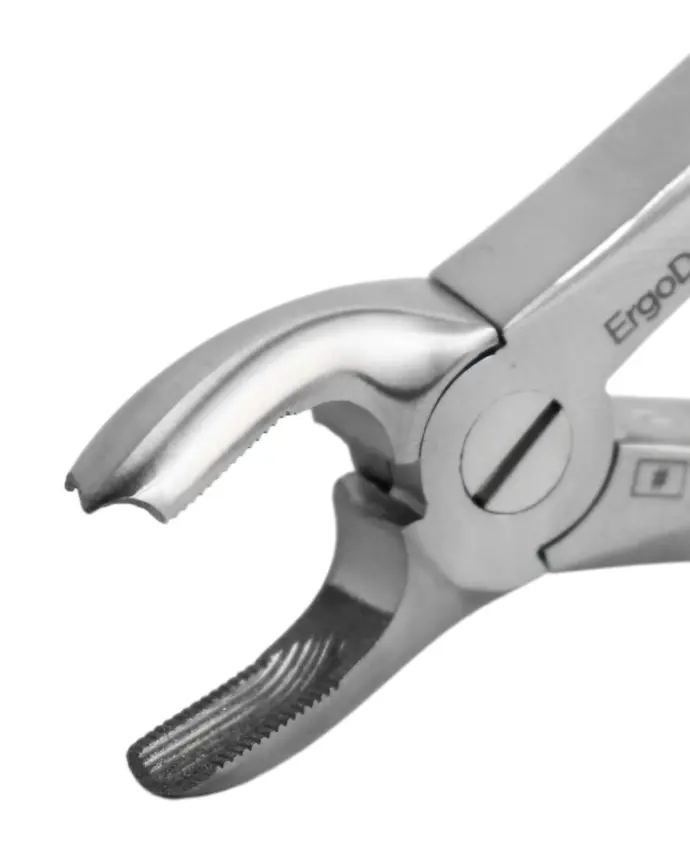
The Diamond series is also the widest: 22 patterns including extra root forceps (Fig. 41, 46, 97, 144, 98 Witzel, 74N), the Fig. 29 and 30S anterior patterns and the Fig. 86, 86B and 99 Hertz lower-molar cowhorns.
See all Diamond EX-Forceps or order the 10-piece Diamond Extraction Forceps Kit, supplied with its own cassette.
3. GripMaster Forceps — maximum grip, minimal pressure
For extractions that demand extra control, the GripMaster series combines diamond-coated beaks with a wider, anatomically contoured beak profile and a balanced handle. The result is a forceps that holds a fractured, fragile or slippery tooth firmly while you apply far less hand force — a real advantage in atraumatic and implant-site extractions.
Eight patterns cover both arches: Upper & Lower Universal, Upper & Lower Anterior, Upper & Lower Molar and Upper & Lower Spade Root.
Read the dedicated article Grip Master Extraction Forceps for technique tips, or pair them with luxators and periotomes from the Atraumatic Extraction Toolkit.
4. Child and Junior EX-Forceps — smaller instruments for smaller patients
Primary teeth have short, divergent roots and thin enamel, and a child’s mouth leaves little room for adult beaks. ErgoDenta’s Child Extraction Forceps are scaled accordingly, with the same steel, hinge quality and ergonomic handle as the adult range.
Child EX-Forceps (Standard and Diamond)
Seven patterns cover the primary dentition: Fig. 137 (upper incisors), Fig. 139 (upper premolars), Fig. 3 (upper molars), Fig. 51S (upper roots), Fig. 5 (lower incisors), Fig. 6 (lower molars) and Fig. 7 (lower roots). Each is available in Standard and in a Diamond Child version.
Junior EX-Forceps
Sized between child and adult, the Junior series suits teenagers, mixed dentition and adults with limited opening: Fig. 7K (upper molars & incisors), Fig. 37 (upper incisors), Fig. 13K (lower premolars), Fig. 22K (lower molars) and Fig. 38 (lower incisors & canines).
5. Extraction forceps kits — one cassette, every tooth
If you are equipping a new surgery or a new clinic, a kit is the fastest way to cover the arch. Each ErgoDenta kit is supplied non-sterile in a sterilisation cassette, so the set stays together from tray to autoclave. (For a full new-clinic shopping list, see our instrument checklist.)
| Kit | Contents | Patterns | Best for |
|---|---|---|---|
| Standard Extraction Forceps Kit5005 | 10 forceps | Fig. 1, 7, 13, 17, 18, 22, 33A, 51A, 67A, 79 | General practice; every adult tooth in one cassette |
| Diamond Extraction Forceps Kit5025 | 10 forceps + cassette | Same ten patterns, diamond-coated | Surgeons and practices doing difficult or high-volume extractions |
| Pediatric Extraction Forceps Kit5010 | 7 forceps | Fig. 3, 5, 6, 7, 51S, 137, 139 | Paediatric and family practices |
| Diamond Child Extraction Forceps Kit5020 | 7 forceps | Same seven patterns, diamond-coated | Paediatric surgery; fragile primary teeth |
How to choose: matching the forceps to the case
- Intact crown, routine extraction → the Standard Fig. pattern for that tooth (chart above). Fig. 1, 7, 13 and 22 handle most of a general practice week.
- Wet field, caries, short or fragile crown → the same Fig. in the Diamond series; the grit holds without extra squeeze.
- Bifurcated lower molar → a cowhorn (Fig. 86A / 86 / 86B): the beaks engage the furcation and lift with leverage instead of grip.
- Fractured tooth or root remnant → root patterns (Fig. 51A, 41, 46, 97, 144 upper; 33A, 74N, UK lower) and, before the forceps, a luxator or root elevator from the Elevators range.
- Implant site or atraumatic protocol → GripMaster with periotomes and luxating elevators (how to combine them), then a bone file to smooth the socket (bone files & rongeurs).
- Children and small mouths → Child Fig. 3–139 or the Junior K-patterns.
Care and compliance. All ErgoDenta extraction forceps are surgical-grade stainless steel, fully autoclavable in standard cycles, CE-marked under EU MDR 2017/745 and manufactured under ISO 13485; ErgoDenta is also FDA registered. Distributors will find the documentation checklist in our EU MDR guide.
Feel the difference
Comfort matters when you hold an instrument all day, and that is where these forceps stand out: balanced in the hand, a handle that keeps the wrist neutral, and beaks that do the gripping so your fingers don’t have to. Simple, reliable and made for everyday use — that is the ErgoDenta difference. Explore the complete Extraction Forceps collection or the wider Extraction range with elevators, luxators and root-tip picks.
Frequently asked questions
Which extraction forceps do I need for each tooth?
What is the difference between Standard and Diamond EX-Forceps?
When should I choose diamond-coated extraction forceps?
What are GripMaster forceps?
Do you have extraction forceps for children?
Is it better to buy a kit or individual forceps?
How do ErgoDenta Fig. numbers relate to American #150, #151 and #18R?
Are ErgoDenta extraction forceps autoclavable and CE-marked?
Equip every extraction with ErgoDenta
Standard, Diamond, GripMaster and Child forceps — 3,300+ ergonomic instruments, CE-marked and shipped from Denmark.